

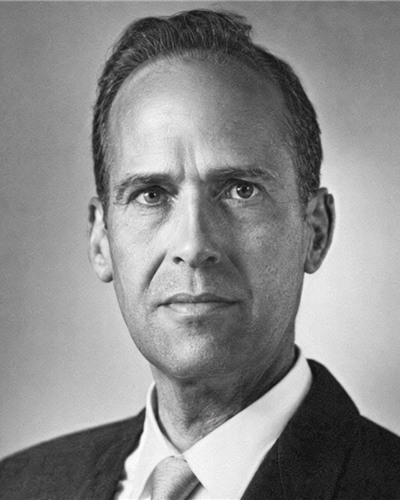
J. M. Hurst (1924–2005) was an American engineer and author who brought signal-analysis tools to the study of prices: averages, filters and decomposition into oscillations. In his 1970 book, he sought to connect these measurements to buying and selling decisions.
From engineering to markets
The introductory note The Author dates his interest in the stock market to 1960. It reports studies in physics and a twenty-five-year aerospace engineering career, with experience in electronics and signal analysis. This background helps explain the question guiding the work: how can an oscillatory component be distinguished from the rest of price movement?
In 1969, he founded Decision Models, Inc.; in 1970, Prentice-Hall published The Profit Magic of Stock Transaction Timing. The Reason author note dates computerized CycliTec aids to 1971 and the complete course to 1973.
The Cyclic Analysis article appeared in 1974. Decision Models is distinct from CycliTec Services, listed as the course’s publisher.
Hurst: birth, death and age
According to Peter Eliades’s MTA obituary, Hurst was born on September 2, 1924, in Salina (Kansas) and died on August 18, 2005, in Roseville (California), aged 80. Eliades also recalls the book as the origin of his own professional interest in cycles.
Master path
Study J. M. Hurst in a clear order
Begin with the essential idea, move to the procedure, and finish with what can invalidate the reading.
- Start here Hurst's operating philosophy: timing, measurement, and limits Why Hurst puts timing at the centre of trading, and how to separate his historical hypothesis from a strategy that has actually been tested.
- Understand the model Hurst's five principles: the cyclic model Hurst's five cyclic principles explained: summation, commonality, variation, nominality, and proportionality, with examples and limits.
- Learn the procedure Hurst nominal cycles: duration and variation Hurst nominal cycles explained clearly: the duration ladder, a 26-week worked example, variation, practical use, and analytical limits.
- Testing and limits Hurst's cyclic-analysis pitfalls: three causes of failure Hurst separates security shocks, fading amplitude, and overlooked slow components; this entry translates those pitfalls into modern risk controls.
The documented contribution
A model of price motion
The Profit Magic of Stock Transaction Timing, published by Prentice-Hall in 1970, presents price motion as a combination of components with different durations. The nominal cycle scale provides reference periods; it does not say that every trough must arrive on a fixed date. Duration, amplitude, and relationships between components remain estimates.
From model to tools
Curvilinear envelopes, bands around price, are used to study oscillations on several scales (Ch. 2). Valid trend lines, or VTLs, are already described in the book (Ch. 4, p. 78). Centered averages and half-span/full-span procedures use windows tied to the duration of the cycle being studied (Ch. 6); filters and spectral analysis develop the numerical decomposition (Ch. 11). Moving from model to signal depends on these choices, not simply on the presence of a regular curve.
The book and the course are different sources
The 1974 article describes phase analysis and diamonds; for VTL/FLD signals it refers to the course. The verified reconstruction does not include a complete primary copy of the course. For later procedures, the post-book path separates sources and interpretations: they are not retroactively attributed to 1970.
Limits of the method and the sources
On p. 175, Hurst himself warns that Fourier decomposition can represent even a straight line as a sum of oscillations: the calculation alone does not prove that the original process is cyclic or justify projecting its periods into the future. This is an essential distinction between describing data and demonstrating a predictive mechanism.
A cycle estimate is not a certain forecast. A centered average is plotted in the past relative to the last observation used: reading it as if it had already been available at that position introduces future information. The book makes this displacement explicit on p. 98. A hand-drawn envelope also involves judgment; parameters, available data, costs and risk must be stated when testing a procedure.
The book documents the method and the author’s reported results, not independently verified present-day effectiveness. The obituary is a posthumous professional recollection; Hickson is a later interpreter.
What to study
- Operating philosophy — the timing problem Hurst seeks to address.
- Five principles of the 1970 model — the assumptions underlying his reading of prices.
- Nominal cycles — compare the “26-week” label with the historical measurement of about 21.4 weeks.
- Cyclic analysis pitfalls — check for forced interpretations and limits of testing.
After these steps, the Hurst tradition path leads to the tools and the post-book formulation. For advanced study, pair filter response and endpoint error with out-of-sample testing: what information would have been available when the decision was made?
Sources
- J. M. Hurst, The Profit Magic of Stock Transaction Timing, Prentice-Hall, 1970: introductory note The Author; Ch. 2, pp. 32–41; Ch. 4, p. 78; Ch. 6, pp. 97–99; Ch. 11, p. 175. Printed page numbers. Google Books bibliographic record.
- J. M. Hurst, “Cyclic Analysis”, Reason, May 1974: Predicting Price Reversal Timing, Figure 3, action-signals passage, author note and references 5–6.
- Peter Eliades, “In Memory of James M. Hurst”, Technically Speaking, September 2005, p. 1. The dates on p. 1 take precedence over the conflicting age on p. 2.
- David Hickson, The 10 Core Concepts of Hurst Cycles: an example of later exposition, separate from Hurst’s works.
Related entries
Hurst tradition · Nominal cycles · Curvilinear envelope · Spectral analysis · Traders and traditions