

In simple terms — Dow's legacy is not a ready-made trading system: it is a collection of averages, editorials, and observations that other authors transformed into the tradition now called Dow Theory.
| Period | 1851–1902 |
| Role | Financial journalist; co-founder of Dow Jones & Company and The Wall Street Journal |
| Contribution | Market averages and observations on price movements |
| Corpus | Editorials, mainly from 1899–1902; no signed manual on “Dow Theory” |
Master path
Study Charles H. Dow in a clear order
Begin with the essential idea, move to the procedure, and finish with what can invalidate the reading.
- Start here Dow Theory Dow Theory is the tradition built from Charles H. Dow's editorials and systematised by Nelson, Hamilton and Rhea. It studies market movements, confirming averages and congestions without constituting an automatic strategy.
- Understand the model The three market movements in the Dow tradition Dow distinguishes the primary movement, a secondary reaction or rally, and the daily fluctuation. The three scales coexist, and their historical durations are not universal parameters.
- Learn the procedure The Dow line: accumulation, distribution and breakout In the Dow tradition, a line is a narrow range maintained by the averages for a significant period. Only a confirmed breakout helps identify accumulation or distribution.
- Testing and limits Confirmation between the averages in Dow Theory In Hamilton's formulation, the industrial and railroad averages corroborate a movement when they take the same direction. They need not turn on the same day, and non-confirmation alone does not amount to a reversal.
Who he was
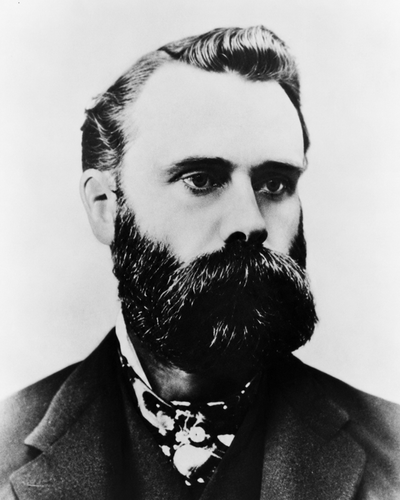
Charles Henry Dow worked as a journalist before founding, with Edward Jones and Charles Bergstresser, the financial news agency that became Dow Jones & Company. The Wall Street Journal began publication in 1889, with Dow as its first editor.
On 3 July 1884 he published an average composed of eleven stocks—nine railroads and two industrials. The Dow Jones Industrial Average debuted on 26 May 1896 with twelve companies. These averages made it possible to observe the market as a whole, reducing the weight of events affecting one individual stock. Their economic significance reflected the America of their time: industrial production visibly depended on railroad transportation.
Dow wrote no book on technical theory and left no definitive sequence of operating rules. His observations were preserved and organised after his death.
From the editorials to Dow Theory
The documented genealogy is essential to avoid attributing later formulations to Dow:
| Date | Author and work | Role |
|---|---|---|
| 1899–1902 | Charles H. Dow, Wall Street Journal editorials | Observations on averages, movements and speculation |
| 1903 | S. A. Nelson, The A B C of Stock Speculation | Collects editorials and speaks of “Dow's Theory” |
| 1922 | W. P. Hamilton, The Stock Market Barometer | Develops confirmation, lines and the reading of the averages |
| 1932 | Robert Rhea, The Dow Theory | Systematises the corpus as a treatise |
Dow Theory is therefore a tradition constructed over time, not a single text written by Charles Dow.
The documented contribution
The averages as a representation of the market
An average aggregates different stocks and makes a general market movement visible when it may not emerge from an individual price. This is the origin of the market as a “barometer”, an idea developed especially by Hamilton.
Simultaneous movements
In the editorials collected by Nelson, Dow compares the market to the sea: the primary movement, secondary swings and daily fluctuations coexist at the same time. The durations reported in the sources already differ between Nelson and Hamilton; they are not universal parameters to transfer to modern markets without testing.
Confirmation between averages
Hamilton formalised the corroboration between the industrial and railroad averages. The two averages need not turn on the same day: they must ultimately indicate the same direction. A non-confirmation makes a reading provisional; it does not automatically amount to an opposite signal.
The “line”
A prolonged narrow range in the averages was called a “line”. For Hamilton it could precede accumulation or distribution, but the character of the range became readable only after a confirmed breakout.
What Dow did not say in this form
Many modern introductions summarise Dow Theory through “six tenets”. The summary is useful for teaching, but combines Dow's editorials, formulations by Hamilton and Rhea, and later textbooks.
In particular, “volume must confirm the trend” is not a rigid rule signed by Dow. Hamilton observed recurring tendencies in volume, allowed for exceptions, and considered it less significant than commonly believed. Confirmation between the averages has a more precise role in the historical corpus.
The automatic association of three movements with three fixed-duration “trends” is also a later rationalisation. Cyclepedia preserves the differences between the sources instead of flattening them.
Advanced level: why study him today
- to understand the historical origin of indexes as tools for reading the market;
- to distinguish a primary scale, a secondary reaction and daily noise;
- to treat confirmation as corroboration, not certainty;
- to see how a doctrine develops through editorial layering;
- to avoid turning historical observations into an automatic strategy without testable rules.
Today's markets, indexes, costs and economic structure differ from those of Dow and Hamilton. Any application to ETFs, futures, sectors or other assets is a modern adaptation that must be disclosed and tested.
Sources
- S. A. Nelson, The A B C of Stock Speculation, 1903, preface and chs. V–IX, digitised edition.
- William Peter Hamilton, The Stock Market Barometer, Harper & Brothers, 1922, chs. I, III, XIII and XV, digitised edition.
- Robert Rhea, The Dow Theory, Barron's, 1932, Open Library bibliographic record.
- S&P Dow Jones Indices, history of the Dow averages.
- Encyclopaedia Britannica, Charles Henry Dow.