

"The stock market is a device for transferring money from the impatient to the patient."
| Period | b. 1930, Omaha (Nebraska) |
| Vehicle | Berkshire Hathaway (control since 1965) |
| Lens | Value investing — the opposite pole from trading |
| Masters and sources | Benjamin Graham (The Intelligent Investor); Charlie Munger; the annual shareholder letters |
Who he is
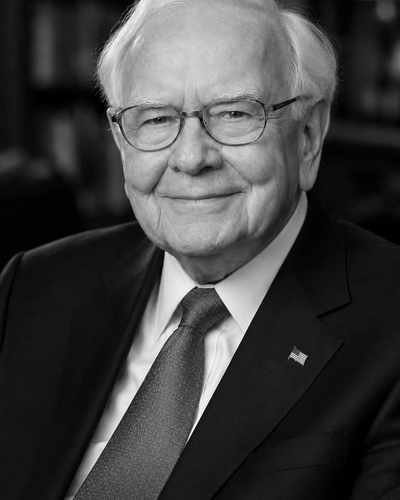
The "Oracle of Omaha" is in this gallery for a precise reason: he is the counterpoint every trader must know. A student of Benjamin Graham at Columbia, he took control of a declining textile mill — Berkshire Hathaway — and turned it into the world's most famous investment vehicle: roughly 20% compounded annually for almost sixty years, documented every year in shareholder letters that have become a free course in finance. He does no timing and uses no charts: his declared edge is a time horizon no manager under quarterly pressure can afford.
Contribution
- Price ≠ value — Graham's legacy made proverbial: in the short run the market is a voting machine, in the long run a weighing machine. Mr. Market is a moody partner to exploit, not to imitate.
- The circle of competence — operate only where you truly understand the business; the size of the circle matters less than knowing where its edge lies.
- From Graham to Munger — the documented evolution: from "mediocre companies at extraordinary prices" to "wonderful companies at fair prices" — quality compounding over time beats the one-off discount.
- Temperament as the edge — "be fearful when others are greedy, and greedy when others are fearful": emotional discipline as the primary competitive advantage, ahead of intelligence.
- Structural patience — "our favourite holding period is forever": the long horizon as arbitrage against an ever-faster market.
What traders learn from him
- That there is another craft with rules opposite to yours: knowing which game you are playing — and not mixing them mid-match — avoids the classic error of the losing trade "turned investment".
- His edge is structural, not informational: a horizon others cannot hold. The question to ask yourself: what is the structural advantage of your process? (see edge)
- The investor's mindset serves the trader too: about total capital, drawdowns and your own career you reason as an investor, even when you operate as a trader.
Study path
Value investing and owner mindset: long horizon, moat, price vs value.
| # | Step | Entry |
|---|---|---|
| 1 | Investor mindset | |
| 2 | Fundamental analysis | |
| 3 | Patience and conviction |
Three cases to study: American Express 1964 (salad oil crisis — buy when others sell); Coca-Cola 1988 (moat + global brand); 2008 crisis (preferred investments in Goldman Sachs and GE). Berkshire rule: "Price is what you pay; value is what you get" — tactical trading is different; here you learn not to confuse horizon and tool.
Start with fundamental analysis →
Related concepts
- investor-mindset · capital
- diversification — and his famous critique: "protection against ignorance"
- edge · patience
Sources
- Berkshire Hathaway — shareholder letters, Buffett's primary annual record of investment principles and performance.
- Berkshire Hathaway — official home, company and governance context.
Links
- trader
- ray-dalio · jim-simons — the other ways of winning without discretionary trading
- jesse-livermore — the exact opposite: same market, contrary craft