

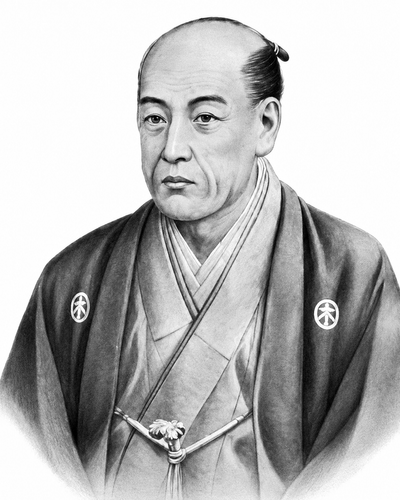
In plain words — Munehisa Homma was an eighteenth-century rice trader from Sakata. He is often called the inventor of candlestick charts, but the surviving evidence does not establish that claim: the modern chart form appeared much later.
Who he was, in brief
The current authority record of Japan's National Diet Library identifies Honma Sōkyū, also read Munehisa, as a rice-market trader who lived from 1717 to 1803. Cyclepedia retains “Munehisa Homma” as its main name because that form is common in international trading literature; the alternative readings and the Japanese name 本間宗久 remain searchable aliases.
A Sakata City Museum exhibition describes Homma as the fifth son of the founder of the merchant family. It reports that he helped manage the family business and increased its wealth through rice trading. The same municipal account remembers him as a “god of the market”, but this is later local historiography, not a contemporary performance record.
Sakata, Osaka and the Dojima market system
Japan Exchange Group documents an official spot and futures market for rice bills at Dojima from 1730, with membership and clearing functions comparable to those of later organised exchanges. It also records that Dojima prices travelled over long distances through couriers and flag signals.
Those facts describe the market system, not a private network run by Homma. Local accounts connect his career first with the Sakata rice market and later with Osaka and Edo, but the sources consulted do not provide a contemporary trading register that proves he personally organised the communications network or allows every reported campaign to be reconstructed.
Two works that must not be confused
*San-en Kinsen Hiroku*: Ushida's text
Library catalogues attribute San-en Kinsen Hiroku (三猿金泉秘録) to Ushida Gonzaburō, not to Homma. The corrected edition catalogued by the National Diet Library dates to 1851, while its preface is dated 1755. The Japan Securities Dealers Association also lists the work under Ushida. Its maxims must therefore not be quoted as Homma's words.
*Sōkyū-ō Hiroku*: the tradition attributed to Homma
The Japan Securities Dealers Association separately lists Sōkyū-ō Hiroku (宗久翁秘録), traditionally dated 1796, under Homma's name. The later publication that can be verified directly through the National Diet Library is the distinct Shōnai Honma Sōkyū-ō Isho (荘内本間宗久翁遺書), compiled and published by Hayasaka Toyozō in 1894.
This makes the work important evidence for the tradition transmitted under Homma's name, but not a verified autograph or a contemporary printed edition. Claims drawn from it should be described as attributed to Homma through a later textual transmission.
Did Homma invent candlestick charts?
The available archival evidence says that this should not be presented as a fact. A 2016 study published by the Nippon Technical Analysts Association found no early source establishing Homma as the creator of candlesticks. It distinguishes the irregular Sakata-ashi described in later literature from a regular-time OHLC candle and traces the recognisable modern form to developments in the Meiji period, long after Homma's death.
Homma therefore belongs in the history of Japanese rice-market thought, not as the documented sole inventor of the modern OHLC candlestick. The “Sakata Five Methods” likewise belong to a later attribution tradition unless an earlier source can be produced.
What remains useful in the Homma tradition
The Japan Securities Dealers Association keeps the maxims attributed to Sōkyū-ō Hiroku separate from those of Ushida and other Edo-period authors. In that later compilation, Homma's tradition emphasises waiting instead of chasing a move, treating unanimous consensus with caution, sizing a position in relation to available capital, and pausing after a loss before acting again.
These are principles of process, not a complete trading system and not evidence of historical profitability. A modern reader can compare them with sentiment analysis, position sizing and loss control, while keeping the modern concepts separate from an eighteenth-century attribution.
For advanced study, the central task is textual rather than graphical: identify which edition contains a maxim, who compiled it and how far the surviving document stands from Homma's lifetime. That source chain matters more than attaching a famous name to a familiar chart.
Limits of the evidence
Cyclepedia has not identified a contemporary account book, trading log, profit-and-loss record, autograph manuscript or verified period portrait that would substantiate the popular numerical stories about Homma's results. Institutional histories establish the rice-market setting; municipal sources preserve local biography; the texts attributed to him survive through later transmission.
The sources therefore support Homma's identity as a major figure in Sakata's rice-market tradition and the later circulation of rules under his name. They do not prove that he invented candlestick charts, authored San-en Kinsen Hiroku, created a personal relay network or achieved any precise modern-style performance figure.
Study consensus and its limits →
Sources
- National Diet Library — authority record for Honma Sōkyū — life dates, occupation, readings and variant names.
- Sakata City Museum — exhibition no. 220 — municipal biography and the later local tradition surrounding Homma.
- Japan Exchange Group — Dojima Rice Exchange — 1730 authorisation, futures trading, clearing and market-wide price communications.
- National Diet Library — Kōsei San-en Kinsen Hiroku — 1851 edition and catalogue attribution to Ushida Gonzaburō.
- Japan Securities Dealers Association — sources of the market maxims — separates Ushida's 1755 work from the 1796 text attributed to Homma.
- National Diet Library — Shōnai Honma Sōkyū-ō Isho — record of Hayasaka Toyozō's 1894 compilation.
- Nippon Technical Analysts Association — “Exploring the formation of candlestick charts”, 2016 — archival reconstruction of the later development of candlestick charts.
- Nippon Technical Analysts Association — candlestick formation analysis — institutional summary placing the modern chart in the late Meiji period.
- Nippon Technical Analysts Association — Technical Analysis Handbook 4 (PDF) — traditional attribution and the handbook's assessment that the Five Sakata Methods are a later work of unknown authorship.
- Japan Securities Dealers Association — attributed maxims on consensus, position size, pausing after a loss and waiting.
Links
Traders and traditions · Futures · OHLC candlestick · Sentiment analysis · Position sizing · Price action discipline