The paperSession.
Anatomy of a turning pointThe event

Ethereum changed its engine.

September 15, 2022. The Merge takes the network from miners to validators.
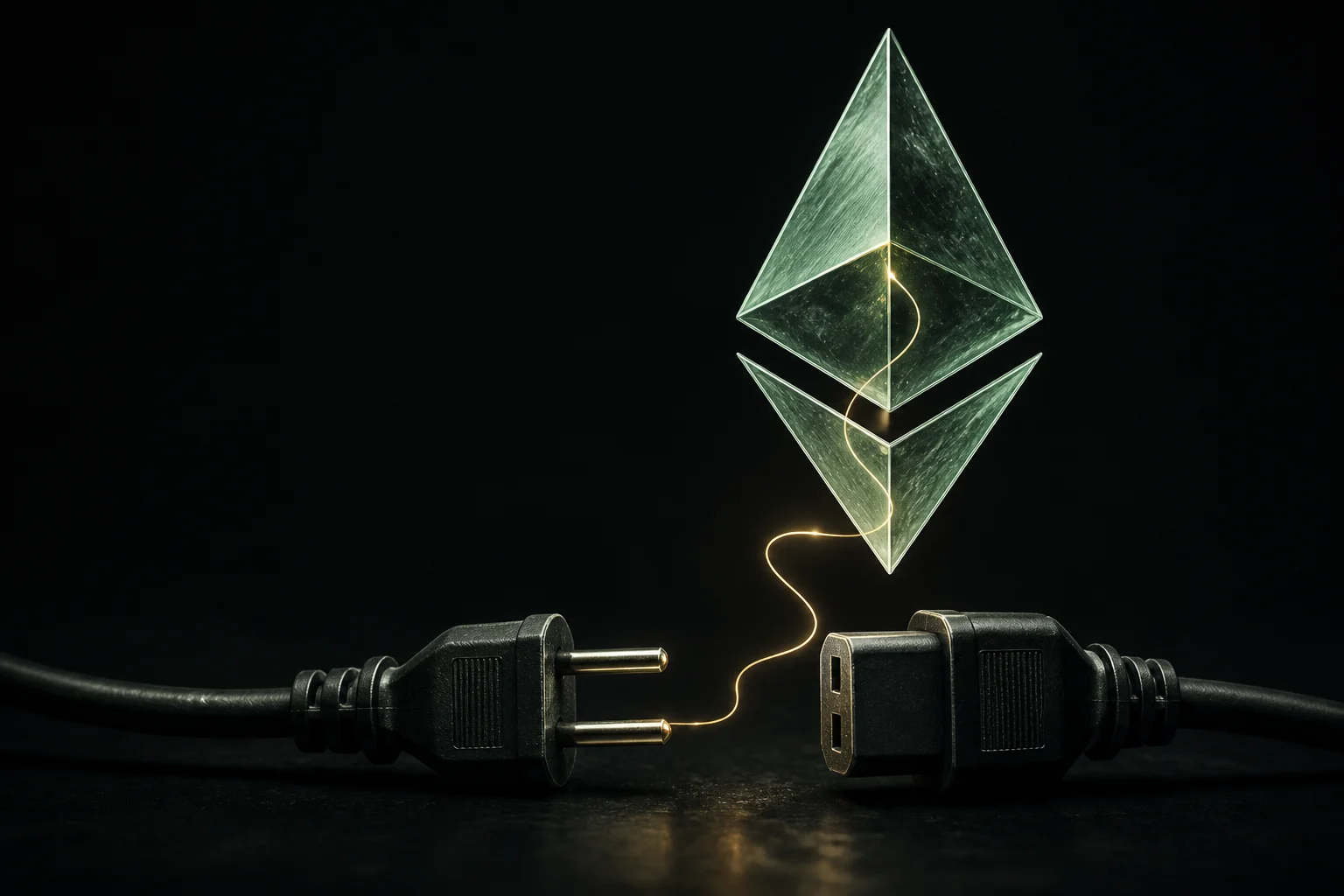
Conceptual illustrationConceptual illustration · SESSION
Read the source ↗15 / 09 / 2022
Anatomy of a turning pointBefore

A race to compute.

Miners consumed electricity to compete to produce blocks.

Read the source ↗ETH / THE MERGE
Anatomy of a turning pointAfter

ETH at stake.

Validators commit capital. Breaking specific rules can cost them part of their deposit.

Read the source ↗ETH / THE MERGE
Anatomy of a turning pointThe scale

−99.95%

The reduction in energy use estimated by the Ethereum Foundation before the Merge.

Ethereum Foundation estimate · May 2021 ↗
1relative units

2,000 units before, 1 after. A relative scale, not live energy consumption.

Anatomy of a turning pointContinuity

The history remains.

Accounts, contracts and transactions survive the change. Ethereum does not start from scratch.

PROOF OF WORKPROOF OF STAKE
THE MERGE15.09.2022
Same accounts · same contracts · same history
Read the source ↗ETH / THE MERGE
Anatomy of a turning pointThe point

Less energy. Space is still contested.

The Merge changes consensus. Fees depend on demand and the space available.

Energy↓Consensus
≠
CapacityDemand for space
Read the source ↗SESSION / September 7, 2026
SESSION / THE MERGE
In plain terms

What the Merge changed — and what it did not

The cards are a visual anatomy. This article is the longer reading of 15 September 2022: consensus, the energy estimate, and why fees did not automatically fall.

What changed on 15 September 2022

The Merge connected Ethereum’s execution layer to the consensus of the Beacon Chain. Validators replaced miners in block production. ethereum.org’s Merge page is the primary public account of that switch. The network’s history was preserved: ETH holders did not need to convert tokens, and contracts kept their addresses.

The Beacon Chain had already run separately since December 2020. The Merge was the join, not the invention of proof-of-stake. Proof-of-work mining ended for Ethereum at that moment; the accounts did not start from zero.

What the −99.95% means

The figure comes from a rough estimate published by the Ethereum Foundation in May 2021, with assumptions about hardware and the number of operators. The chart on the plates expresses the ratio as 2,000 units before and 1 after. It is not a live wattmeter. Later studies use different methods; actual consumption changes over time.

ethereum.org’s energy-consumption page remains the Foundation’s public door to that claim. SESSION cites the 2021 blog and does not pretend the chart is a laboratory measurement.

Security is a deposit, not a spell

Validators commit ETH as collateral. Certain consensus violations, such as contradictory signatures, can destroy part of that deposit. The mechanism does not remove every risk. The proof-of-stake documentation on ethereum.org describes the rules; it does not promise that nothing can go wrong.

SESSION’s cards show the shift from computing power to capital at stake. The longer text adds only this: the slash is specific, not total. Readers who need the full rule set should open the source, not this panel.

Fees still follow demand

Changing consensus alone did not significantly expand the space available for transactions. Fees depend on demand relative to that capacity. The Merge did not guarantee cheaper block space. The last card on the plates is the point: less energy is not the same as more room.

The cards already say accounts, contracts and history survive. This paragraph only cites it: the Merge page and the proof-of-stake docs are the place to read the mechanism, not a biography of the chain.

How to read this panel

That is why the deep-read exists beside the cards. The visual special stays thirty seconds. The citations — Merge page, 2021 energy blog, proof-of-stake docs, energy-consumption page — sit in the list. SESSION does not sell a token and does not call a market.

Sources and method

  1. Ethereum.org — The Merge ↗
  2. Ethereum Foundation — Ethereum's energy usage will soon decrease by ~99.95% ↗
  3. Ethereum.org — Proof-of-stake ↗
  4. Ethereum.org — Energy consumption ↗

Conceptual illustration: SESSION · Imagegen. September 7, 2026.